Why Agencies Waste Hours Finding Answers (And How AI Fixes It)
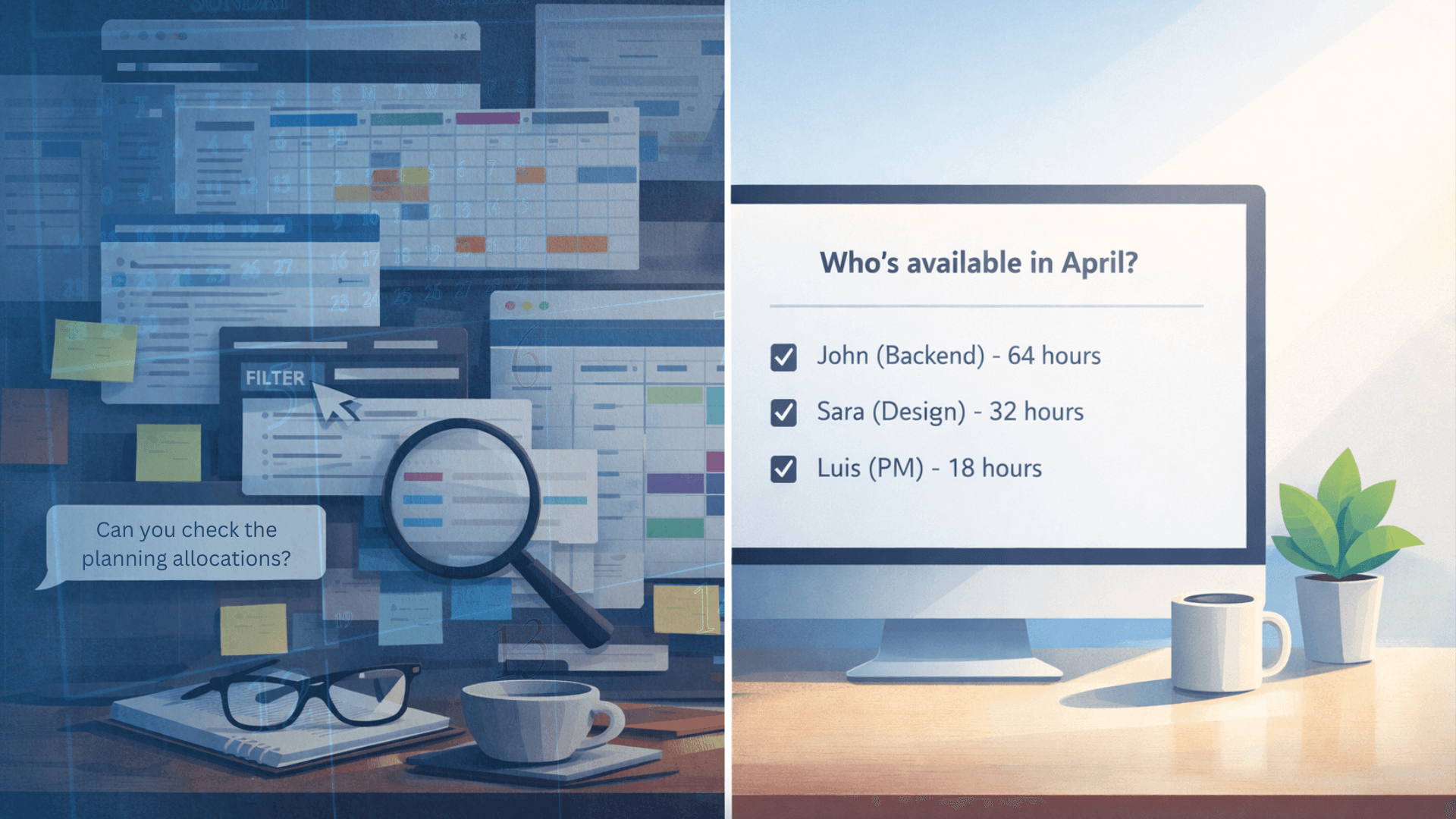
Every agency leader has had this moment.
- A sales opportunity appears.
- A client asks for a start date.
- A project manager pings you with a simple question: “Who’s available next month?”
- You open your resource planning tool.
- Ten minutes later, you’re still not sure.
Not because the data isn’t there — but because it’s scattered across dashboards, filters, spreadsheets, and people’s heads. This is one of the most common productivity bottlenecks in agencies today, and it has nothing to do with effort or talent.
It’s about how information is accessed.
The Hidden Cost of Finding Information
Most agencies don’t realize how much time they lose just answering basic operational questions:
- Who’s free in April?
- Which team is overallocated?
- How many billable hours do we actually have?
- Can we take on this new project without burning people out?
On paper, the data exists.
In reality, getting to it looks like this:
- Open resource planning
- Filter by role
- Cross-check allocations
- Compare with PTO
- Export to Excel
- Check pipeline
- Message managers to confirm
And even after all that, the answer is usually:
“I think these three people might be available.”
That uncertainty slows decisions, creates rework, and leads to overcommitment.
Why Dashboards Don’t Solve This
Dashboards are good at showing data, not answering questions.
They require interpretation.
They assume perfect setup.
They depend on humans connecting the dots correctly — every time.
And the more dashboards you add, the more fragile the system becomes.
This is why agencies with “great tools” still struggle with:
- capacity planning
- utilization forecasting
- resource availability
- staffing decisions
- delivery risk
The problem isn’t visibility.
It’s cognitive load.
A Simple Example: Old Way vs AI Way
Traditional Way (Slow)
Question: Who’s available in April?
Process:
- 6 dashboards
- 4 filters
- 1 export
- 10+ minutes
- 2 follow-ups
Answer:
“Maybe John, Sara, and Luis.”
AI Way (Instant)
Question: Who’s available in April?
Answer (in seconds):
- John (Backend) — 64 hours
- Sara (Design) — 32 hours
- Luis (PM) — 18 hours
Calculated automatically from:
- current allocations
- PTO
- project plans
- pipeline probability
- forecasts
No clicks.
No exports.
No guessing.
From Clicking Tools to Asking Questions
This is the real shift.
Instead of navigating tools, you ask questions.
Instead of assembling data, the system does it for you.
Instead of guessing, you get a decision-ready answer.
That’s what AI agents enable — not automation of tasks, but automation of judgment.
Why Generic AI Can’t Do This
Chatbots and generic AI tools don’t understand how agencies actually work.
They don’t know:
- how you define capacity
- what “available” really means
- how billable vs non-billable time affects forecasts
- how sold, planned, and delivered work interact
- when an answer should be conservative vs optimistic
A real AI agent must understand your business logic, not just your data.
How Metric AI Agent Works
Metric AI Agent is connected directly to your system of record — projects, budgets, time tracking, CRM, forecasts, and resource plans.
It understands:
- your roles and teams
- your utilization rules
- your availability logic
- your financial model
- your planning assumptions
So when you ask a question, the answer is:
- accurate
- consistent
- contextual
- instant
No dashboards required.
The Real Productivity Gain
Agencies don’t lose time because people are slow.
They lose time because answers are hard to find.
AI agents remove that friction by turning scattered systems into one intelligence layer.
Because speed isn’t about working faster.
It’s about finding the right answer immediately.
And that’s what modern professional services automation should feel like.
If you’ve ever thought, “We have the data, but it’s still hard to get
answers,”
it might be time to stop clicking dashboards — and start asking questions
instead.